
Elder Network Participates in GiveMN Give to the Max
GiveMN is on November 20th in 2025.
This special campaign started in 2009, and is still going strong through 2025!
Each year, thousands of donors from around the world support Minnesota organizations on GiveMN.org throughout the year and during Give to the Max, Minnesota’s holiday for generosity. Every nonprofit and school is invited to participate!
Elder Network registered our nonprofit and continues to raise support through the web platform throughout the year. Please consider your participation in the following ways:

How This Campaign Changes Lives
Pat’s Story
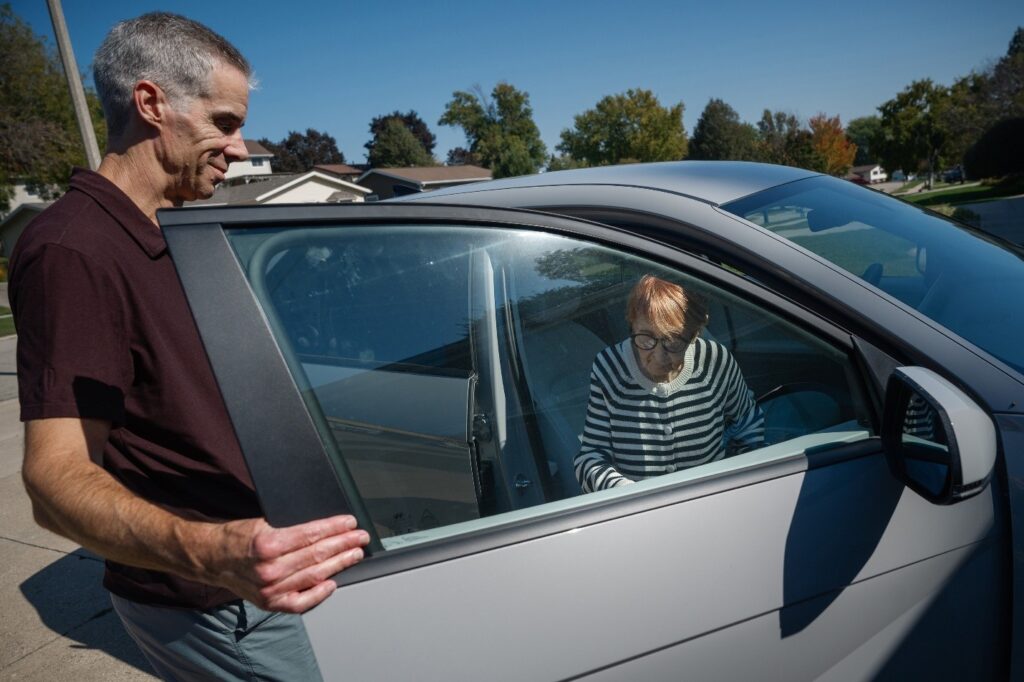
Tom Byrne, a volunteer driver with Elder Network, picks up client Pat Harlan at her home on Sept. 26, in southwest Rochester. Harlan said she relies on the Elder Network for transportation about once a week. Harlan said, “I would have to not live in my house,” if transportation through Elder Network wasn’t an option for her.
About once a week, Pat Harlan grabs her purse and corrals her blonde poodle, Banjo, in anticipation of a knock at her door.
On one September Friday afternoon, that knock came from Tom Byrne. Meeting Harlan at the door, Byrne helped Harlan down the front steps of her house and to his car.
“He’s such a nice man,” Harlan said of Byrne. “I’m blind, so I never get to see his face. Kindness usually shows in your face, but I never get to see that.”
Byrne is a volunteer driver with the Elder Network’s Medical Transportation Program, a service that 175 seniors in Olmsted County have used this year. Last year, volunteers like Byrne completed more than 2,000 rides in and around Rochester.
Without the service, Harlan said, “I would have to not live in my house. I’d probably have to go to senior living.”
The program aims to fill gaps in transportation access for seniors who cannot drive, said Donna Proeschel, who oversees the program at Elder Network, a nonprofit that serves seniors in Olmsted, Wabasha and Winona counties.
“Appointments often happen when traditional, other services,” such as city buses, “aren’t running at the time,” Proeschel said. “People need a 7 a.m. appointment or … later in the afternoons. Sometimes chemotherapy’s done on a weekend these days.”
Additional barriers could include mobility issues that make getting on and off a bus difficult, living too far away from a bus stop and fixed incomes that make the cost of taxis or rideshares untenable, said Kathy Scheid, Elder Network’s executive director.
“And I think one of the important factors of our program is we’re not just a ride service,” Scheid said. “We really care about the individual.”
When a senior signs up for the program, they go through an intake process so that Proeschel and her volunteers know if anyone else lives with them, who their emergency contacts are, the state of their mental and physical health and so on.
With this information, volunteers can provide another service beyond the rides: keeping an eye out for any health declines or other troubling changes.
“We may talk to their emergency contact, ‘So-and-so seems to be forgetting a lot more often; we’re a little bit concerned,’” Scheid said. “If someone doesn’t come to the door when their ride arrives, the driver will try to ascertain what happened.”
Each week, after clients schedule their rides, the group of about 35 volunteers select the rides that work for them, whether it’s one ride per month or one ride every day, Proeschel said. For Byrne, he said he averages three rides per week.
“Some rides are quicker, some rides take a little longer,” Byrne said. “Just really depends on where they’re going.”
And while the majority of rides are for doctor’s appointments and similar medical visits — which are given priority on the schedule — some rides are for non-medical appointments, like haircuts and social events.
“Getting your hair done is an important part of your emotional well-being and feeling good about yourself,” Proeschel said.
While clients pay a small fee for each ride, some of the program’s financial backing, as of 2023, comes from the United Way of Southeast Minnesota.
“Access to health care rose to the top as one of the community health needs assessment priorities” that year, said Grace Pesch, vice president of community impact at the local United Way. “Transportation has consistently come up in the community as one of the biggest reasons why people are not able to access health care.”
“We’ve got the best in the nation,” added Proeschel. “But if you can’t get to it or you can’t afford to get to your medical services, what’s the purpose?”
Contact health reporter Dené K. Dryden at 507-281-7488 or ddryden@postbulletin.com.
These examples demonstrates how your donation can help
change lives and keep our community a great place.
Please stay updated with current events in this season of giving opportunities, through scrolling down and reviewing important event details on this page. Please donate and support the work that we do in the community to continue providing such services at low-cost or no-cost to individuals caring for and receiving care.
We always provide the opportunity to clients to donate on a voluntary contribution, but especially for the over 65% of our clients who fall under 250% of the Federal Poverty Line ($39,125 annual income for an individual and $52,875 annual income for a couple), we would greatly appreciate your support. For those who cannot contribute financially to support our programming, we need the support of the community to continue improving the lives of older adults and their caregivers. Living on a fixed income makes the burden of paying for services heavy on older adults of all incomes, as the costs of living increase and their income remains the same.
We support those who typically fall through the cracks and go without the necessary supports they need to live safely-but only because your contributions make it possible to create a better reality for these older adults and caregivers. Your support helps these people to live thriving, rewarding lives! Please choose to help us continue to change lives and keep our community a great place to live, work, and play.
Follow and Share More Stories on Facebook
You can read stories of real people being impacted by isolation, chronic conditions, caregiver burnout, living with dementia, caring for those with dementia, the limiting effects of aging, and other challenges in their lives. They are thriving amidst these challenges, and this is only made possible through the support of those essential community members, such as yourself, who are providing them with the funding that they need to access services for affordable prices.

Here is How You Can Participate
GiveMN is on November 20th in 2025.
DONATE
You can make a donation of any amount towards Elder Network’s services and programs to provide encouraging relief for caregivers and care receivers. You can contribute several different ways:
VOLUNTEER
Elder Network seeks a variety of volunteers. Please see our Volunteer Page for current needs, volunteer application and forms.
Those 55 and better and their caregivers have the opportunity to thrive and lead rewarding lives.
Contact Elder Network for services the following counties.
Olmsted County
1130 ½ 7th St NW Ste #205,
Rochester, MN 55901
Phone: 507-285-5272
Fax: 507-285-0884
Wabasha County
PO Box 52
Lake City, MN 55041
Phone: 651-565-3237
Winona County
402 E 2nd St.
Winona, MN 55987
Phone: 507-452-0580
PROGRAMS
INFORMATION
SUPPORT
CONNECT